ASSIMILATION

The assimilation of the Bulgarian ethnic minority in Serbia is so obvious a fact that even the authorities do not try to conceal it. Instead, a subtle mechanism has been forged, one transforming slowly but steadily the ethnic Bulgarians in Serbia into either Serbs or Yugoslavs. There are families in Tsaribrod already in which the grandparents and the parents are ethnic Bulgarians, while someone of their sons declares himself to be an ethnic Serb. Something which can  be seen in no other people and ethnic minority.


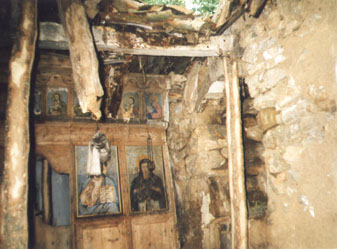
The St. Petka Monastery,
village of Smilovtsi, near Tsaribrod

In one way or another, in the course of decades, the local people have been persuaded that they do not need to be taught  their mother tongue at school, or that the young people should seek higher levels of education in Serbia rather than in Bulgaria, or else that in Serbia's interior "there is a job and a place to live in for every ethnic Bulgarian". At present, the pupils of Bulgarian origin are not taught their mother tongue. This is one of the internationalized issues of this ethnic minority, which the Yugoslavian authorities refuse to resolve.

According to the latest population census in Yugoslavia, only 25 214 individuals have identified themselves as ethnic Bulgarians. In 1948 the number of ethnic Bulgarians in Yugoslavia ran up to 61 140. Over a ten-year period, between 1981-1991 alone, the number of ethnic Bulgarians in Serbia fell by 10 971 persons. Where have the rest of all these people gone, provided  that no natural disaster is known to have befallen them?

On the other hand, between 1971 and 1991 the number of ethnic Bulgarians in the Pirot and Babuoushnitsa areas   decreased from 5 006 to 1 746. In 1971 as little as 2 082 individuals from the Pirot municipality declared a Bulgarian ethnic identity; in 1981 their number was 2 101, and in 1991 - only 854. In the municipality of Baboushnitsa 2 924 persons reported their Bulgarian origin, in 1981 - 2 102, and in 1991 - 892. What is more, as a result of a massive campaign  launched by the authorities among the Bulgarian population in Tsaribrod and Bossilegrad of favouring the so-called Yugoslavian identity, in the latest population census 22.4 per cent of the total population of the Tsaribrod region have declared themselves to be Yugoslavs, while in Bossilegrad this percentage is 14.1. The fact should be pointed out that throughout Serbia the proportion of people reporting to be Yugoslavs is only 3.2 per cent. It is only superfluous to make any comments in this case.
A LITTLE MORE ABOUT US

The non-governmental organization Helsinki Committee for Protecting the Rights and Freedoms of the Ethnic Bulgarians in Yugoslavia was registered in 1997 at the Federal Ministry of Justice. The organization was founded to monitor and investigate human rights records in the territory of present-day Yugoslavia, including the rights and liberties of the Bulgarian minority in Serbia. The major goals of the organization are to defend the European values, the freedom of mind and speech, equality in the legal protection of all citizens, as well as the promotion of civil society. Its sphere of activity includes the working out of periodic, monthly, quarterly, or annual reports on the human rights record of the Bulgarian minority in Serbia. The framework of this monitoring embraces also the holding of conferences and "round tables" on specific minority issues, as well as the publication of thematic bulletins and other printed materials in the Bulgarian language.


One of the symbols of cultural unity of the population on both sides of the border running along the ridge of the Balkan Mountains is the Chiprovtzi kilim rug. It is woven both in the Chiprovtzi and the Pirot regions.


Why it is "Wonderland" | The Bulgarians' Land | The People of Bulgaria | History | Ethnography and Folklore |
Bulgarian Cuisine | Perspective of the Day

Copyright 1997-2011 ® “OMDA” Ltd. Âñè÷êè ïðàâà çàïàçåíè